
Practical
Will a Dumpster Actually Fit? Hillside and Alley Access
In most towns the debris decides the container. In this valley the driveway usually gets there first, and it is worth understanding why before you book.
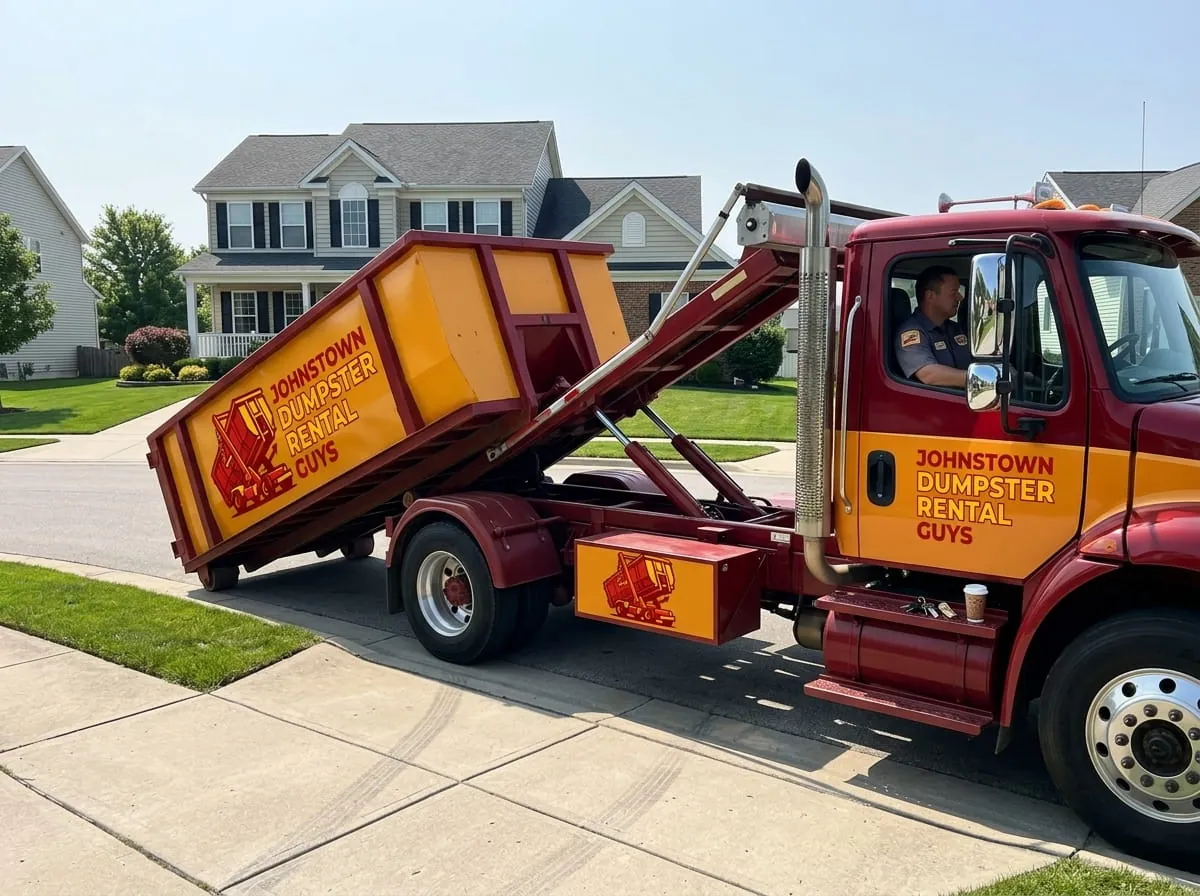
Placement decides more often here
Everywhere we work, the conversation runs: what are you throwing away, how much of it, where will it go. In the Johnstown valley the third question overtakes the first often enough that we have learned to ask it first.
The reason is structural. The city sits in a steep river valley at a confluence, with boroughs built up the hillsides above it. The valley floor was laid out for houses without cars; the hillside streets were cut into grades that were never going to be gentle. Neither was designed with a thirty-foot roll-off truck in mind.
How much room a truck actually needs
Worth being concrete, because "will it fit" is hard to judge from the kerb.
- Length. A 20 yard container is 22 feet, a 15 yard is 16 feet, a 10 yard is 12 feet. Add roughly 10 more feet of clear run behind it for the truck to roll the container off.
- Width. Around 8 feet for the container, plus room either side to work — call it 10 to 12 feet of usable width.
- Height. Roughly 22 feet of clear overhead for the bed to raise. This is the one people never think about and it is the most common constraint in the tree-lined boroughs.
- Approach. The truck has to line up reasonably square. A tight turn from a narrow street into a narrow drive can rule out a placement that would otherwise be fine on space alone.
So a 20 yard needs about 32 feet of clear driveway. That is a genuinely long driveway, and a great many of them here are not.
Grade: the constraint people forget
Southmont, Westmont, Upper Yoder and parts of every hillside borough have driveways that drop or climb sharply from the street.
Two things follow. A loaded container has to sit level enough to be hauled safely — winching several tons up onto a truck bed at an angle is not something we improvise. And on a steep drive the workable placement is often at the street end rather than up by the house, which means you carry further but the job actually happens.
If your driveway is steep, that is not a refusal — it is a planning conversation. Tell us roughly how steep and we will tell you honestly what works.
Narrow streets and rear alleys
The valley boroughs — Ferndale, East Conemaugh, Franklin, South Fork, Cambria City, much of Windber — were built dense, and a good number of properties have no driveway at all or are served by a narrow rear alley.
Rear alleys are the harder case. They are frequently too narrow for the truck to line up, sometimes have overhead wires low across them, and often cannot be reversed out of safely. Where an alley genuinely will not work, the options are street placement with a permit from your borough, or an arrangement with a neighbour who has a usable drive.
Both take a little organising, which is why we ask early rather than on the morning. More on the permit side here.
Tree canopy and overhead lines
Westmont's elm-lined avenues are one of the nicest things about the area and one of the most common reasons we have to change a placement.
The truck bed rises to roughly 22 feet to roll a container off. Mature street trees over a narrow borough street are frequently lower than that, and so are some older utility drops to the house.
Look up before you book. If there is a branch or a wire over the spot you had in mind, we will find another one — but we would rather know first.
What boards do, and the frost underneath
A roll-off does not spread its weight across its footprint. It sits on two steel rails and concentrates the load onto a small number of contact points, typically the rear wheels and the front of the rails. A loaded 20 yard puts something in the order of several thousand pounds onto each.
Timber or plywood under the rails spreads that across a much larger area, and our drivers carry boards on every truck as standard. They go down before the container touches the surface and again on collection, because the drag-on is as damaging as the drop-off.
What matters locally is what is underneath. Frost goes deep in the Laurel Highlands: water in the ground freezes, lifts the slab or the asphalt above it, then releases in spring — and not evenly. Do that every winter for fifty years and you get the cracked, heaved and hollow-underneath driveways that are entirely normal here. A driveway that looks sound in September may have a void under it that only shows when a point load finds it.
If you have frost cracking, a lifted slab edge, or a section that rocks slightly underfoot, point it out and we will place away from it.
The spring thaw is the risky season
Counterintuitive but consistent: the worst time to put a loaded truck on an unpaved drive or a lawn here is not deep winter. It is the spring thaw, when the frost comes out and the base is saturated and soft under a crust that still looks solid.
Frozen ground carries weight extremely well. A gravel drive that is rock solid in January can be porridge in early April. On the Somerset plateau that window runs later still, because it holds snow and frost longer than the valley does.
So if you have unpaved access, mid-winter is often a better bet than early spring, and we may suggest waiting a fortnight rather than rutting your drive.
What to tell us when you call
- How long the driveway is — roughly, in car lengths is fine
- How steep it is, and whether it climbs or drops from the street
- Whether the street is narrow, and whether access is by a rear alley
- Whether there are branches or wires overhead
- The surface, and whether it has frost cracking or anything that rocks
- The time of year, if the access is unpaved
None of that takes more than a minute, and between them those six answers decide the container size, the placement and whether we bring a swap into the plan. It is the single most useful conversation you can have with us before booking.
Need a container in Johnstown?
Call and describe the job. Three minutes on the phone gets you a size recommendation, a flat rate and a delivery window — and we will tell you if a smaller, cheaper container is the right answer.
Call (814) 999-8622